

3 Signs a Procurement Workflow Is Ready for AI Support
A practical checklist for spotting procurement workflows that are repetitive, document-heavy, and structured enough to benefit from AI — without forcing AI into processes that are not ready.
2026-01-17 · 9 min read
Introduction
Not every procurement process is a good candidate for AI support. Some workflows are too ad hoc, too political, or too dependent on informal judgment to benefit from automation. Others are repetitive, document-heavy, and structured enough that AI can remove real friction.
The challenge is telling the difference early. Teams often start with enthusiasm and only later discover that the process they chose has no stable output format, inconsistent inputs, or review steps that cannot be supported by structured AI output.
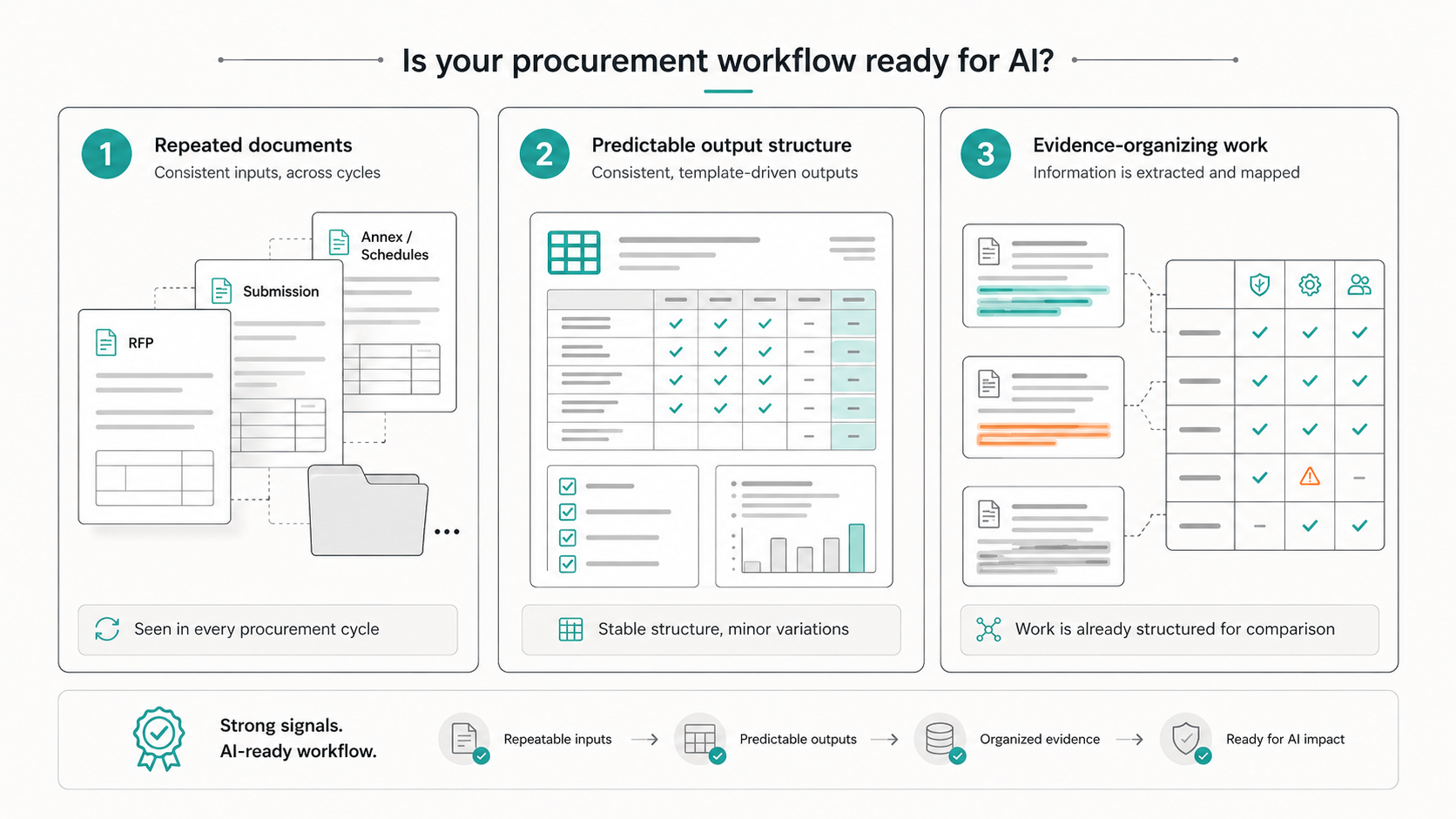
These three signs help identify procurement workflows that are more likely to succeed with AI support — because the inputs repeat, the deliverable is predictable, and reviewers need help organizing evidence rather than making unsupported judgment calls.
Sign 1: The team reviews similar documents repeatedly
The strongest signal is repetition. If the same types of documents arrive again and again, the workflow is a natural candidate for structured support.
In procurement, that often means RFQs, RFPs, technical specifications, bidder submissions, annexes, compliance declarations, pricing sheets, and supporting evidence packs. The content changes, but the document types and review pattern stay largely the same.
Repetition creates leverage. Once the workflow understands the expected file types and review logic, each new case becomes faster to process because the structure is already defined.
- Repeated tender or RFx document sets
- Standard bidder submission folders with similar annex structure
- Recurring compliance or technical specification reviews
- Contract packs with comparable clause and obligation patterns
- Periodic vendor or supplier evaluation cycles
Sign 2: The output has a predictable structure
AI support becomes much more useful when the team already knows what kind of output the process needs. If the deliverable varies wildly from case to case, automation is harder. If the deliverable follows a stable format, automation becomes realistic.
Examples include a criteria comparison table, a completeness checklist, a tender evaluation report, a bidder scoring matrix, or a contract section map. These are not vague "summaries." They are defined work products with sections, labels, and review expectations.
Predictable outputs also make human review easier. Reviewers know where to inspect, what to challenge, and what to sign off on.
- Evaluation reports with defined sections and comparison logic
- Completeness or compliance checklists tied to tender requirements
- Bidder comparison matrices or scoring tables
- Contract codification or clause extraction outputs
- Internal review notes formatted for committee or approval use
Sign 3: Reviewers spend time finding and organizing evidence
The third sign is operational pain. If reviewers spend significant time locating requirements, checking whether documents were submitted, comparing files manually, or assembling notes for a committee, AI can help structure that work.
This is often the hidden cost in procurement review. Reading is only part of the job. The larger burden is organizing information into a usable review record: what was required, what was provided, what is missing, and how cases compare.
AI is most valuable when it reduces that organizational overhead while leaving final judgment with the responsible team.
- Manual extraction of criteria from long tender documents
- Checking submission folders against requirement lists
- Building comparison tables across multiple bidders
- Searching for supporting evidence across annexes and attachments
- Preparing committee packs from scattered review notes
What does not qualify — yet
Some procurement workflows are poor first candidates even if they are important. Highly strategic sourcing decisions with heavy negotiation dynamics, one-off bespoke procurements, or processes with no stable review format may not be ready for AI support.
Likewise, workflows where the main bottleneck is policy interpretation, stakeholder alignment, or external approval timing will not be solved by better document processing alone.
That does not mean AI will never help. It means the organization should start with workflows that have repeatable inputs and defined outputs, then expand from there once the team trusts the format and review model.
A simple readiness checklist
Before introducing AI into a procurement workflow, ask these practical questions.
- Do similar document sets arrive often enough to justify a repeatable workflow?
- Can we define the output format clearly enough that reviewers would recognize it?
- Is a meaningful part of the work about organizing evidence, not just making judgment calls?
- Can human reviewers remain accountable for final decisions?
- Would a structured report, matrix, or checklist actually reduce review time?
Where to start
If a workflow passes these checks, start with one narrow use case rather than an entire procurement function. Tender evaluation, validation of file completion, and contract codification are common starting points because they combine repetitive inputs with structured outputs.
Pilot with a defined upload set, a fixed output format, and a small reviewer group. Measure whether the output reduces evidence-gathering time, improves consistency, and produces material the committee can actually use.
Successful pilots usually expand because the team trusts the deliverable — not because the AI sounded impressive in a demo.
Takeaway
A procurement workflow is ready for AI support when the inputs repeat, the output is structured, and reviewers need help organizing evidence into a usable review record.
If those conditions are present, AI can support the process without replacing accountable human judgment. If they are not, the better move is to clarify the workflow first — then automate the parts that are truly repeatable.
Related resource
A practical checklist for spotting procurement workflows that are repetitive, document-heavy, and structured enough to benefit from AI — without forcing AI into processes that are not ready.