

The Difference Between AI Answers and AI Deliverables
Enterprise teams do not need better chat. They need structured outputs they can review, trace, reuse, and defend — reports, matrices, briefs, and files that fit real workflows.
2025-11-08 · 11 min read
Introduction
Most enterprise AI conversations still begin in the same place: a chat box. Someone uploads a document, asks a question, and gets back a fluent answer. In a demo, that moment often feels like success.
In production, it frequently is not. The answer may be accurate, well written, and even impressive — and still unusable for the work that follows. Procurement committees do not approve vendors from a chat transcript. Legal teams do not sign off on contract reviews from a paragraph of AI prose. Investment committees do not base decisions on a summary that cannot be traced back to source files.
The gap is not intelligence. It is output design. Business workflows do not end at an answer. They end at a deliverable: a report, matrix, checklist, slide deck, brief, or structured file that someone else can inspect, challenge, reuse, and attach to a decision record.
Understanding that distinction is one of the most practical filters for evaluating AI in document-heavy environments.
What an AI answer actually is
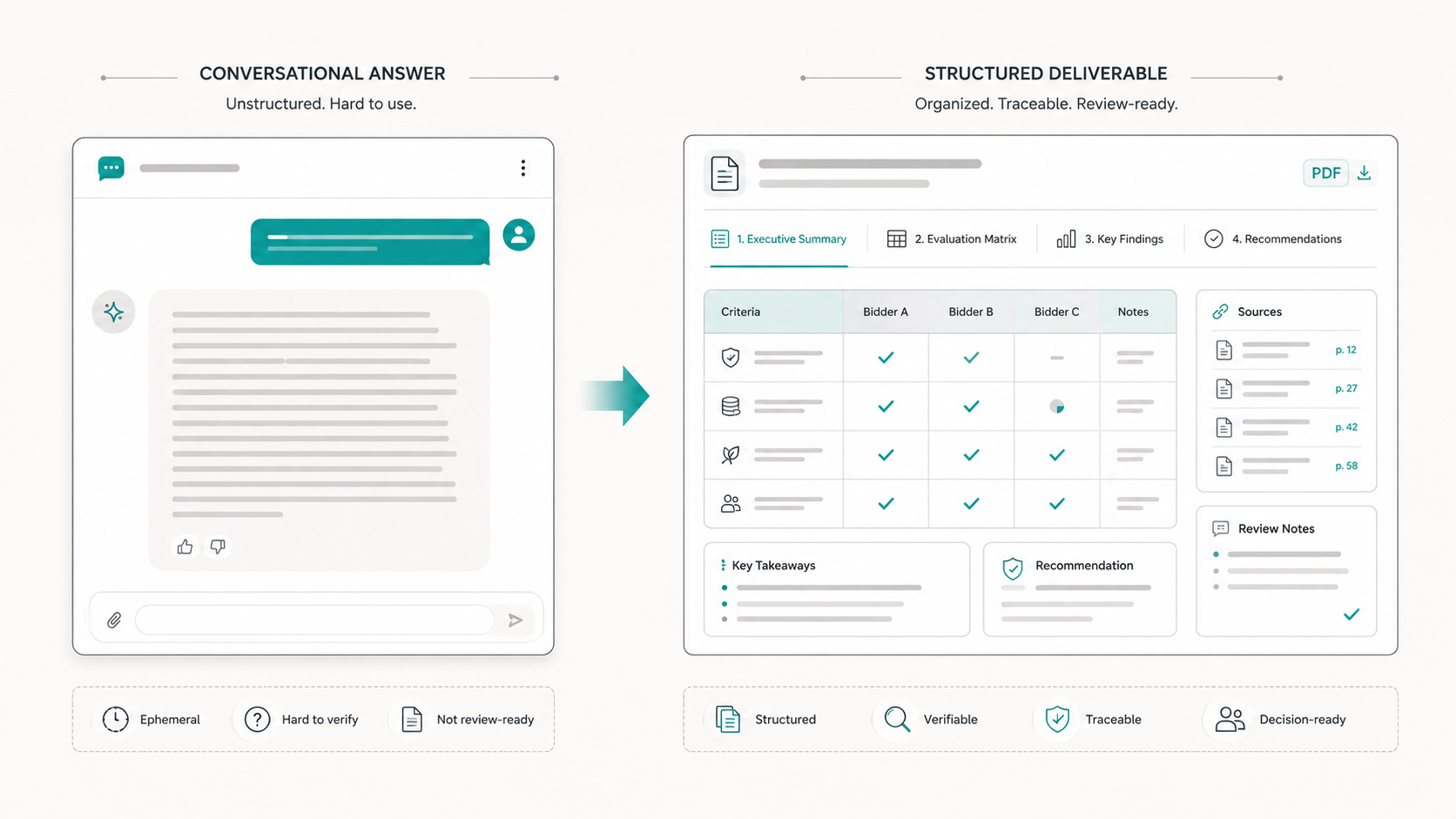
An AI answer is a response optimized for conversation. It is usually free-form text, generated in the moment, shaped to sound helpful and complete. That makes answers excellent for exploration: clarifying a concept, drafting a first pass, comparing options at a high level, or getting unstuck on wording.
Answers are ephemeral by default. They live in a thread. They may not follow a company template. They may combine findings, assumptions, and recommendations in one continuous block of text. They may cite sources inconsistently — or not at all — depending on how the tool was configured.
None of that makes answers worthless. For individual productivity, they can be genuinely valuable. But answers are not designed to be handed off. They are designed to be read once, in context, by the person who asked the question.
- Optimized for readability, not workflow handoff
- Usually unstructured text without fixed sections or labels
- Often missing stable source references tied to specific files or pages
- Hard to compare across runs, bidders, candidates, or time periods
- Difficult to reuse inside templates, committees, or audit trails
What an AI deliverable actually is
An AI deliverable is an output designed for a defined workflow. It is not merely something the model said. It is something the organization can use: a PDF evaluation report, an Excel-ready comparison matrix, a completeness checklist, a PowerPoint slide set in a company template, or a structured briefing with separated findings and reviewer notes.
Deliverables are built around repeatability. The same workflow should produce the same sections, labels, and format every time — even when the underlying documents change. That consistency is what allows teams to review faster, delegate safely, and compare outputs across cases.
In serious enterprise use, deliverables also need provenance. A claim in the output should point back to evidence: a file name, page reference, quoted excerpt, or clearly marked inference. The goal is not blind trust. The goal is inspectability.
This is why the most useful enterprise AI systems behave less like open-ended chat and more like document processors with a defined output contract.
- Structured sections, tables, labels, and review fields
- Output formats that match how the team already works
- Evidence links or source references where claims matter
- Clear separation between extracted facts, inferred points, and reviewer judgment
- Reusable files that can be shared, archived, and compared over time
Answers vs. deliverables at a glance
The difference becomes clearer when you compare what each output gives a team in practice.
- Primary goal — Answer: respond helpfully to a question. Deliverable: produce a work product for review or decision support.
- Format — Answer: prose in a chat thread. Deliverable: report, matrix, checklist, slides, or structured file.
- Structure — Answer: flexible and conversational. Deliverable: fixed sections aligned to the workflow.
- Traceability — Answer: often implicit or absent. Deliverable: evidence and source references where required.
- Reuse — Answer: low; tied to one conversation. Deliverable: high; designed for sharing and audit.
- Human review — Answer: informal reading. Deliverable: explicit inspection, sign-off, or committee use.
- Production fit — Answer: strong for exploration. Deliverable: strong for repeatable operational workflows.
Why impressive answers still fail in serious review
The failure mode is subtle. Teams assume that if the AI "understood" the document, the output is ready. In practice, review teams ask different questions: Where did this come from? What is missing? Which section is this based on? Can I compare this bidder against the others in the same structure? Can I attach this to our internal template?
In procurement, a fluent summary of a tender submission is not the same as an evaluation report with extracted criteria, bidder comparison, scoring notes, and evidence references. Reviewers still have to rebuild the structure manually — which means the AI saved writing time but not review time.
In legal and contract work, a polished summary of obligations may hide the more important need: clause extraction mapped to sections, missing attachments flagged, and risk points separated from neutral description. The answer sounds confident, but confidence is not the same as defensibility.
In HR or investment review, teams often need outputs that fit a committee format: candidate comparison tables, risk/opportunity matrices, missing-information flags, and suggested follow-up questions. A narrative answer may contain useful insight while still leaving the team with extra formatting and verification work.
This is the hidden cost of answer-first AI: the model appears productive, while the organization still pays the full price of turning text into a usable artifact.
What decision-grade output looks like
Decision-grade output does not mean the AI makes the decision. It means the output is strong enough to support one: clear enough to review, structured enough to compare, and traceable enough to defend later.
That usually requires more than prompt engineering. It requires workflow design — defining the expected files, the required sections, the review boundaries, and the output format before the model ever runs.
- Structure that mirrors the review process, not the model's default writing style
- Evidence attached to important claims, especially in procurement, legal, and compliance contexts
- Visible gaps, weak support, and missing items — not just what appears complete
- Separation between extracted information, inferred interpretation, and human reviewer notes
- A format the next person in the process can actually use without rewriting
The deliverable test: five questions before you buy or scale
If you are evaluating AI for a document-heavy workflow, ask these questions about the output — not just the demo.
- Can the system produce the same output structure every time, not just a good answer once?
- Can a reviewer trace important claims back to source files, pages, or excerpts?
- Does the output fit the template or format your team already uses internally?
- Can two cases be compared side by side without manual reformatting?
- Can the result be shared, archived, and reviewed by someone who did not write the original prompt?
Why this changes how teams should design AI workflows
Once you adopt the deliverable mindset, several design choices become obvious.
First, the unit of value shifts from the prompt to the workflow. The question is no longer "What should we ask the model?" but "What work product does this process need to produce?" That reframing alone eliminates many low-value chat use cases.
Second, structure becomes a product requirement, not a nice-to-have. Schema, templates, tables, labels, and section rules are what turn language-model output into operational software behavior. In production systems, structured outputs are increasingly treated like API contracts: predictable, validatable, and safe for downstream use.
Third, human review becomes explicit. A good deliverable shows what was extracted, what was inferred, and what still requires judgment. That makes review faster without pretending the AI replaced accountability.
Fourth, evidence becomes part of the output design. If a workflow supports decisions, the output should help a reviewer verify it — not merely believe it.
Where this shows up in real workflows
The answer/deliverable distinction is not abstract. It shows up anywhere documents move through review.
Procurement teams need evaluation reports and completeness reviews, not chat summaries of bidder files. Legal teams need clause maps, obligation summaries, and issue lists tied to contract sections. HR teams need candidate evaluation tables or slide outputs in a company format. Investment teams need structured assessments with risks, opportunities, and missing information clearly separated.
In each case, the valuable output is not "AI text." It is a working artifact the team can inspect, share, and reuse.
That is also why output galleries matter in evaluation. Teams should not have to imagine what the AI produces. They should be able to see sample reports, matrices, slides, and checklists and ask whether those outputs would actually fit their process.
Takeaway
Enterprise AI value is often misunderstood because the easiest thing to demo is also the least durable: a convincing answer in a chat window.
Real workflow value usually comes from deliverables — structured, review-ready outputs that match how teams actually work. The organizations that get the most from AI in document-heavy environments are usually not the ones with the best prompts. They are the ones that define the output first, design for evidence and review, and treat AI as a production step in a repeatable process.
If an AI tool cannot produce a usable deliverable for your workflow, it may still be useful for individual productivity. But it is not yet solving the operational problem.
Related resource
Enterprise teams do not need better chat. They need structured outputs they can review, trace, reuse, and defend — reports, matrices, briefs, and files that fit real workflows.