
What Procurement Teams Actually Need from AI-Generated Reports
Procurement teams do not need summaries. They need structured, traceable, review-ready reports that help them inspect tender material consistently and defend decisions later.
2026-03-26 · 10 min read
Introduction
Procurement teams are often shown AI summaries as if summarization were the main problem. In a demo, a fluent recap of a bidder submission can look like a breakthrough. In real review work, it usually is not enough.
Tender evaluation, file completion checks, and contract review all involve large document sets, strict requirements, multiple stakeholders, and decisions that may be challenged later. In that environment, teams do not only need to understand a submission. They need to inspect it, compare it, document their reasoning, and show their work.
That is why the most useful AI-generated procurement reports are not generic summaries. They are structured review materials: evaluation reports, completeness reviews, comparison matrices, and evidence-backed findings that fit the procurement process itself.
Procurement review is a documentation problem
Procurement workflows are document-heavy by nature. RFQs, RFPs, technical specifications, bidder submissions, annexes, compliance forms, clarifications, and supporting evidence all have to be read, checked, compared, and recorded.
The pain is rarely "We cannot read fast enough." The pain is organizing the work: finding requirements, mapping submissions against them, identifying missing items, comparing bidders consistently, and preparing material the evaluation committee can actually use.
AI helps most when it reduces that organizational load — not when it replaces the committee's judgment.
- Extracting criteria and requirements from tender documents
- Checking whether submissions appear complete and supported
- Comparing bidders against the same criteria in a consistent structure
- Flagging missing, weak, or unclear evidence
- Preparing review-ready reports for internal committees or audit trails
They need structure, not just text
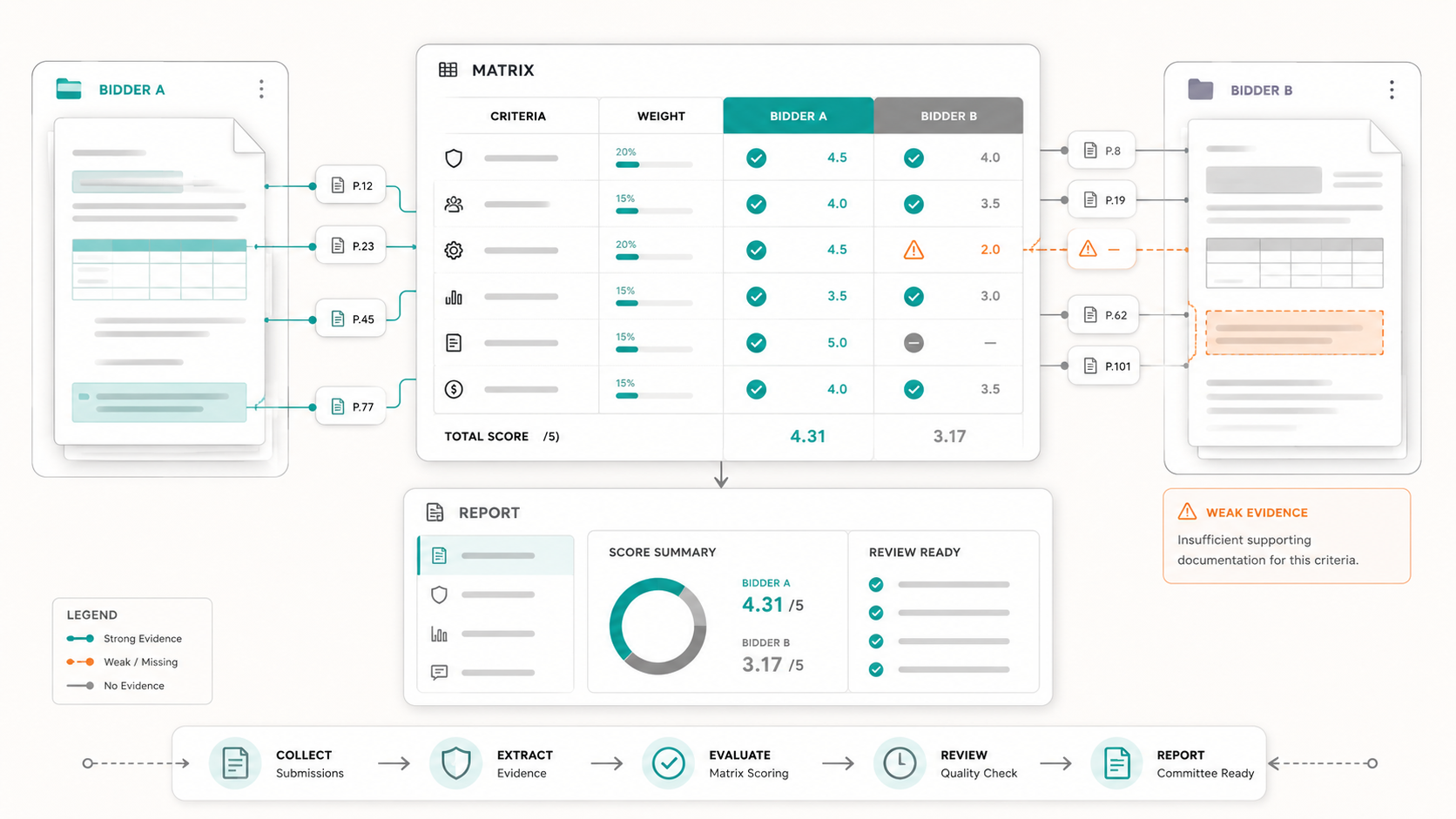
A useful procurement report should mirror the review process, not the model's preferred writing style. That usually means fixed sections, labeled findings, tables or matrices, and clearly separated reviewer notes.
Structure makes review faster because everyone knows where to look. It also makes comparison possible. If three bidders are evaluated, the team should be able to inspect them using the same format — not three different narrative summaries that cannot be aligned without manual rework.
This is especially important in tender evaluation and validation-of-file-completion workflows, where the output is often shared across procurement, legal, technical reviewers, and management.
- Evaluation reports with extracted criteria, bidder comparison, and scoring rationale
- Completeness reviews showing required documents, submitted files, and missing items
- Compliance tables or checklists tied to tender requirements
- Contract or submission summaries organized by section, clause, or obligation
- Review notes separated from extracted findings
They need source references
Procurement reviewers cannot work from assertions alone. If an output says a bidder submitted a required certificate, provided a specific technical detail, or failed to meet a criterion, the reviewer needs to know where that claim comes from.
Source references may include file names, page numbers, section labels, quoted excerpts, or links back to uploaded evidence. The format can vary by workflow, but the principle is the same: findings should be inspectable.
This matters not only for quality control during review. It also matters later, when someone asks why a bidder was shortlisted, rejected, or asked for clarification. A report that cannot be traced back to evidence is difficult to defend.
They need gaps and weak evidence to be visible
One of the most common mistakes in AI-generated procurement output is overconfidence. The report describes what appears to be present, but underplays what is missing, ambiguous, or weakly supported.
Strong procurement reports do the opposite. They make uncertainty visible. If a required attachment seems absent, if a response is vague, if evidence is incomplete, or if a document requires manual inspection, that should appear clearly in the output.
Reviewers do not need the AI to pretend certainty. They need it to accelerate inspection — including the inspection of what is not fully there.
- Missing documents or annexes
- Weak, partial, or ambiguous responses
- Requirements with no clear supporting evidence
- Conflicting information across files
- Items that require manual reviewer judgment
Different procurement workflows need different reports
Not every procurement AI use case produces the same kind of report. Tender evaluation may require a structured comparison of participating companies against extracted criteria. Validation of file completion may require a checklist-style review of one submission folder. Contract codification may require a section-by-section map of clauses, obligations, and deliverables.
The common thread is not the document type. It is the need for a review-ready deliverable that matches the task.
That is why procurement teams should evaluate AI tools based on sample outputs for their specific workflow — not based on a generic chat demo.
What good looks like in practice
A strong AI-generated procurement report should help a reviewer answer practical questions quickly: What was required? What was submitted? What is missing? How do the bidders compare on the same criteria? What still needs human inspection?
It should also be usable by the next person in the process — the committee member, the approver, the auditor, or the colleague continuing the review later.
When AI output meets that bar, it stops being a writing shortcut and becomes operational support for a high-stakes workflow.
- Can the report be reviewed without opening every source file from scratch?
- Can important claims be traced back to evidence?
- Can multiple bidders or submissions be compared consistently?
- Are missing or weak items clearly flagged?
- Can the output be shared as part of the official review record?
Takeaway
Procurement teams do not need generic AI answers. They need review-ready deliverables that match the structure, evidence standards, and decision process of tender work.
The best AI-generated procurement reports help teams compare, verify, and document — not just read faster. If an output cannot support those tasks, it may still be interesting. But it is not yet solving the operational problem.
Related resource
Procurement teams do not need summaries. They need structured, traceable, review-ready reports that help them inspect tender material consistently and defend decisions later.